

Inside The Emanate Great AI Debate: Two Cities, Two Nights, One Result
May 7, 2026
Some questions are too big for a LinkedIn Poll. They deserve a room. Real experts, real stakes, genuine disagreement - and the intellectual courage to sit with an argument that challenges what you already believe.
That is precisely what Emanate Technology set out to create with The Emanate Great AI Debate. In the space of a few months, we took one of the most consequential questions facing Australian business and the people inside it - "Will AI create more jobs than it eliminates by 2030?" - to Brisbane and Melbourne, filled both rooms with some of the sharpest minds in technology, data and AI, and let the argument run.
What happened on both nights was more interesting than any forecast, any think piece, or any set of statistics alone could have produced. And the results, in their own quiet way, said something important about where we actually are with AI right now.
Brisbane Vs Melbourne: Different Rooms, Identical Verdict.
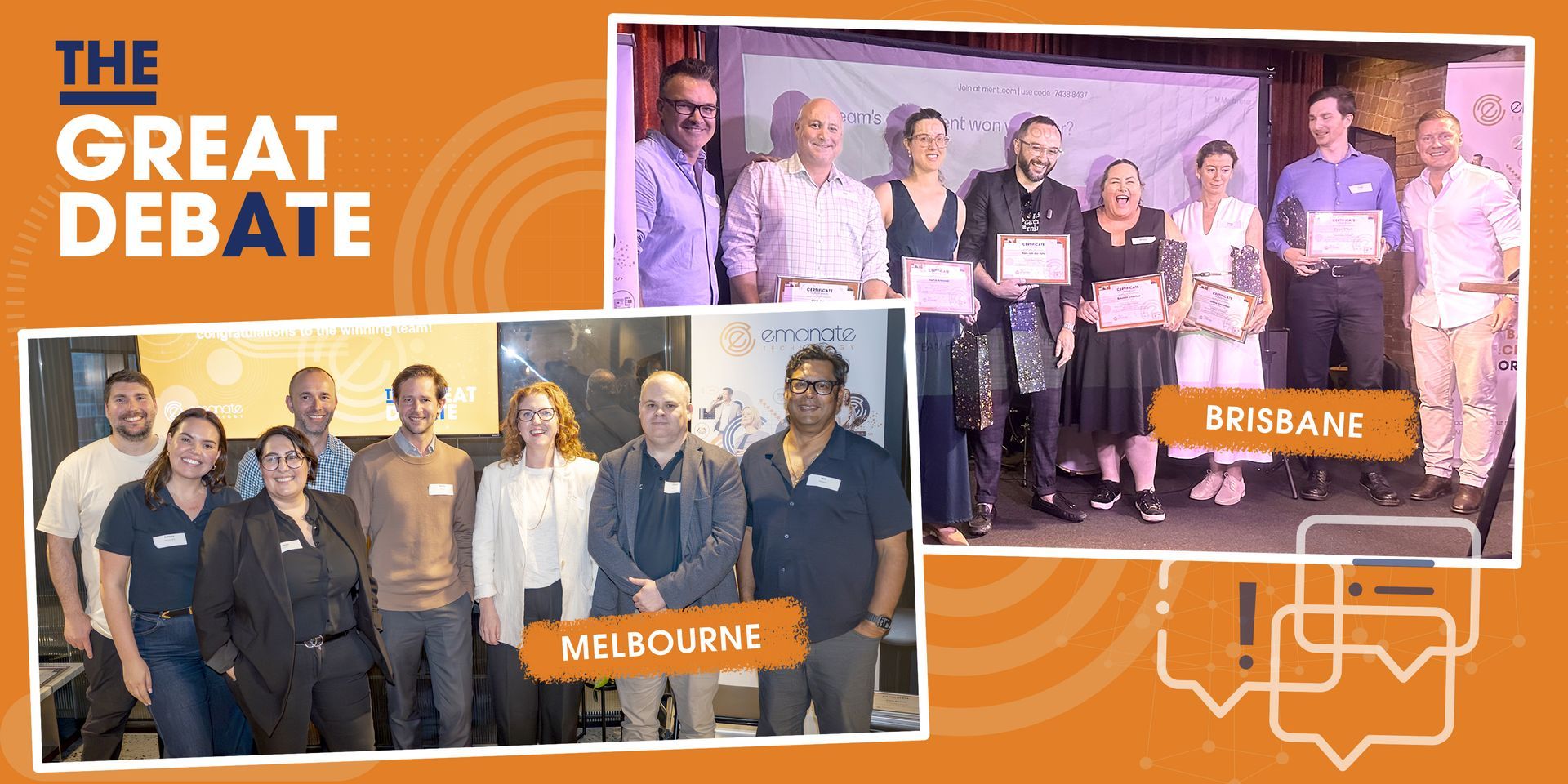
Brisbane came first. Set downstairs, in an atmospheric basement bar that would usually host hoardes of local music fans. A sell-out audience of technology leaders, data practitioners, and curious professionals filed in and, before a single argument had been made, cast their opening votes. The room split exactly in half. Fifty percent believed AI would create more jobs than it eliminates by 2030. Fifty percent did not. A more perfect starting point for a debate would be difficult to engineer.
The For Team made their case with conviction. Llew Jury, Managing Director of Advancer; Roni van der Fehr, Founder of Protego.AI; and Sophia Arkinstall, Founder of AI and Society, argued that the long arc of technological transformation has always bent toward opportunity, and that AI would prove no different. By the time the evening closed, the room had shifted. Convincingly. The Against Team - Brooklin Charlton, Partner at Evokeo; Conor O'Neill, Executive Consultant at Conor.AI; and Emma Liversidge, GM Data and Analytics at The Lottery Corporation - had moved the audience from 50/50 to 76/24 in their favour, a swing of 26 points. Adjudicator Clinton McGregor, Managing Director of Pulse Analytics, called the result with unbridled enthusiasm and commentary throughout the night.
Melbourne followed in March at Emanate's picturesque Cremorne office. A different audience, a different cast, and a different - and equally impressive - MC. The opening vote landed at 54% Against, 46% For, already leaning sceptical, as if Melbourne had quietly read the room before the room had spoken.
The Against Team fought valiantly, Mitch Tomazic, AI and Data Principal Consultant at Neogen Group; Amanda Princi, Head of Data and AI Enablement at Transurban; and Nish Mahanty, Director at Mahanty Consulting, made their case with force and precision. MC Andrew Murphy, CTO of Debugging Leadership, kept the night moving with the kind of deft control and enthusiasm that only comes from someone who genuinely understands the territory (and humour). Clare Kitching, Director of Cambiq; Chris Benson, Executive Director of AI and Data Intelligence at Fujitsu; and Danny Sittrop, General Manager of Advanced Analytics at Crown Resorts, argued the For position with the same composure and credibility that had carried Brisbane, though the pendulum's swing remained over in the Against team's corner (just).
And when the final votes were counted, Melbourne landed at exactly the same place as Brisbane. Not a replica of the opening vote, but a replica of the result: 54% Against, 46% For. The numbers were identical. The voters, however, were not. People had switched sides in both directions. What the scoreboard captured was equilibrium. What it could not capture was the motion underneath it.
That motion - the fact that arguments genuinely moved people, that convictions shifted in real time, that the same final number was reached through different journeys - was perhaps the most telling outcome of all.
What the Against Team Argued
The Against position was never anti-AI. That would be too simple, and the speakers were too sophisticated for simple. What it was, instead, was a challenge to the timeline, and an insistence on honesty about the gap between what AI promises and what it delivers to working people in the near term.
The core of the argument was this: even if AI creates more jobs in the long run, the path there is not frictionless. It passes through a period of disruption that will be felt acutely and unevenly, and declaring victory for a 2030 net positive before that disruption has run its course is a form of optimism that the people bearing the costs are not in a position to share.
The audience comments from Melbourne captured the sentiment with a directness that no speaker could have scripted. "Whilst I appreciate the rainbow that AI might offer, I'm a millennial living through my sixth once in a lifetime crisis. I'm not convinced companies will embrace AI as much as they'll use it to fire." Another: "AI creates uncertainty which contributes to an unstable economy, layoffs. History shows AI is not anything like what we have had before. It is disruptive in a completely different way." And perhaps the sharpest observation of the night: "The FOR team didn't use the best possible argument. The motor vehicle created jobs in a range of areas including environmental protection, alternative energy and public transport. But not by 2030."
That last comment cuts to the heart of why the Against team was persuasive. The historical analogies - the industrial revolution, the shift from agricultural to industrial labour, the arrival of computing - are all accurate over a long enough horizon. But they tend to obscure the decades of transition pain that accompanied each of them. The question was not whether AI would eventually produce a more abundant economy. It was whether it would do so by 2030.
The real-world data visible right now gives the Against position considerable purchase. Australia ranked second globally for tech job losses in early 2026, with AI cited as the primary driver behind every major sacking in the sector. Sydney ranked third globally in absolute terms for jobs cut, behind only San Francisco and Seattle. The ACS reported that Australian firms including Atlassian and WiseTech were among those reorganising workforces in direct response to AI-driven automation. A Resume.org survey of 1,000 hiring managers found that 55% of companies expected layoffs, with 44% citing AI as the main driver. These are not projections. They are the present tense.
What the For Team Argued
The For position rested on something equally grounded: the historical record of every major technological transformation that preceded this one, and the net positive it eventually delivered for employment.
The World Economic Forum's Future of Jobs Report 2025 - drawing on surveys of more than 1,000 employers representing over 14 million workers across 55 economies - projects that 170 million new roles will be created globally by 2030, against 92 million displaced. A net gain of 78 million jobs. McKinsey estimates that up to 1.3 million Australian workers may need to transition into new roles by 2030 due to automation, but frames this as transformation rather than elimination. PwC's AI Jobs Barometer found that augmentable jobs - those where humans work alongside AI - grew 47% across Australian industries between 2019 and 2024.
The For team's argument was that this pattern is not new. Every wave of transformative technology has displaced existing roles while creating ones that were previously unimaginable. The question is not whether the transition hurts - it does - but whether the destination justifies the journey. And by every credible macro-economic measure, AI's destination is a more productive, more capable, and more richly employed economy.
Several audience members held this position with conviction through to the final vote. "New tech improves living standards and drives demand. Free market economics fills the void with more and new supply, which means more and new jobs." And: "Against argued there is uncertainty. I have faith we will ride this wave just like we have every time. Humanity wins." And more quietly, from someone sitting with the complexity rather than resolving it: "Understanding the specific of the question - AI will replace jobs, but new jobs will be available, not just in AI though."
Why the Same Result in Two Cities Is Not a Coincidence
The symmetry of both the arguments and the outcomes - Brisbane at 76/24, Melbourne at 54/46, both in favour of Against - reflects something real about where the Australian technology community sits right now. It is not a community in denial about AI's potential. Everyone in both rooms understood and, in many cases, works directly with the technology. What the Against wins captured was a widespread unease about the gap between the optimistic long view and the difficult near term.
The audience comments that held their positions were often the most revealing. "Nobody knows." "There is too much uncertainty for now, not by 2030." "This will follow the same long dip." These are not anti-AI sentiments. They are honest assessments from people close enough to the work to know that the transition is not a smooth upward curve.
What is striking is that the Against team won both debates without arguing that AI is a net negative. They argued that the specific question - more jobs than eliminated by 2030 - sets a bar that the evidence does not yet clear. It is a precise, intellectually honest position. And two rooms of sharp, engaged, informed people found it more persuasive than the alternative.
Where does Emanate Stand?
We built this debate series because we think the conversation about AI and work deserves more than it typically gets. More rigour than a LinkedIn post. More honesty than a keynote. More texture than a statistic.
Emanate holds no position on the debate question. That is deliberate. We are not the experts. We work with them, recruit them, support their careers, and build the teams that organisations rely on to navigate this technology's arrival. What we have seen in that work - and what both debate nights confirmed - is that the people closest to AI are not the most certain about it. They are often the most thoughtful about what it will and will not do, and over what timeframe.
What we do believe is that the conversation matters. That curiosity and rigour together produce better decisions than either alone. That gathering a room of genuinely smart people around a hard question and letting them disagree openly is more valuable than broadcasting a consensus that does not exist.
And we believe the collaborative future that AI makes possible - one where human ingenuity is freed from the most arduous and repetitive layers of work, pointed at more prolific problems, and supported by tools that extend rather than replace human judgement - is worth working toward seriously and honestly. Not naively. Not in the short term as a given. But as a destination that requires us to be clear-eyed about the road.
The Debate Continues
The Emanate Great AI Debate is not a one-off. Both cities produced the kind of energy that tells you a conversation has further to run, and we will be bringing new topics, new speakers, and new cities into the series.
In the meantime, if you are a technology professional, a data and AI leader, a hiring organisation building capability in this space, or simply someone who thinks these conversations should happen more often and with greater seriousness - we would like to hear from you.
Because the question of what AI does to the way we work is not going to be settled by a debate. But the debate is a better place to start than most.
If you haven’t already, get in contact with the team at Emanate today to become a part of our community.

Made redundant from a tech role? Follow this practical 30 Day plan covering finances, CVs, recruiters, applications, interviews and your next steps.

Discover why specialist technology recruitment agencies offer deeper market knowledge, stronger talent networks and informed hiring support across Australia.

Learn what to write in a follow-up email after an interview, when to send it and how to follow up professionally with practical examples.

See how AI is changing recruitment, including AI skills assessment, the AI hiring process and how to hire AI engineers, with insights from a tech recruiter.